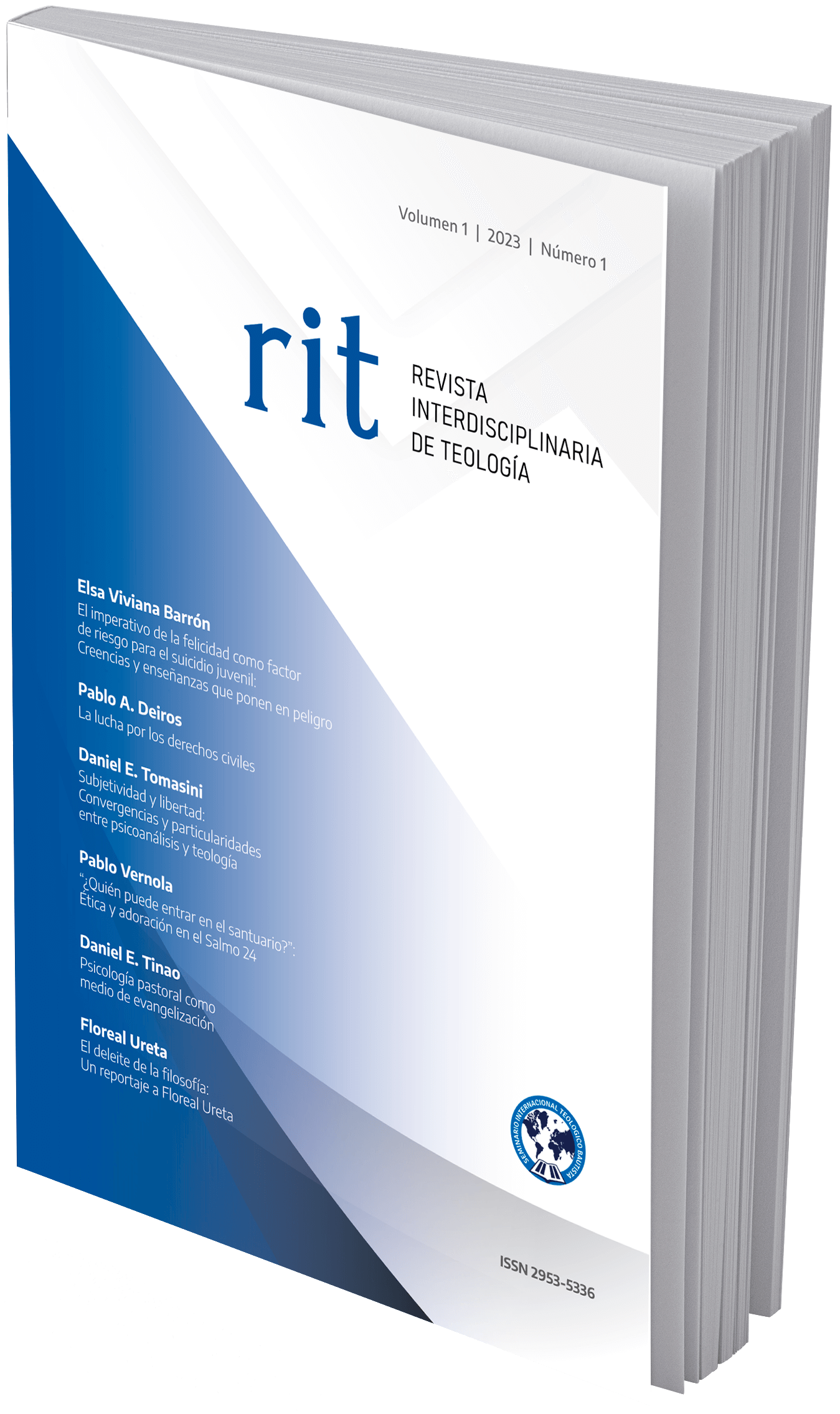
Subjectivity and freedom: Convergences and particularities between psychoanalysis and theology
Convergencias y particularidades entre psicoanálisis y teología
DOI:
https://doi.org/10.67779/rit.14Keywords:
Freedom, Psychoanalysis, Theology, Truth, GodAbstract
This article tries to make psychoanalysis and theology dialogue on the subject of subjective and personal freedom. First, a brief outline will be made on the conception of freedom for psychoanalysis. Some misunderstandings regarding the belief that such a dialogue is impossible due to Freud's atheism will be cleared up. There the limits of the Freudian affirmation will be shown, the fact that Lacan had his differences with Freud regarding the idea of God, and that the theory and practice of psychoanalysis requires the neutrality of the analyst. By removing these obstacles, basic concepts of the discipline under consideration will be explained, whose metalanguage is abundant. Finally, a brief consideration of freedom in psychoanalysis will be made. The second part of the work addresses the issue of freedom from the theological perspective; mentioning the contribution of notable theologians and making a brief outline of the main biblical ideas on the subject. Finally, the convergences and peculiarities inherent to each discipline will be addressed. Here topics related to freedom will be treat: its concept, the convergence of objectives, its relationship with truth, with angst, its prospective structure and, finally, freedom and God. It will be shown, throughout the development, that subjective freedom is transformed into free acts that change the social fabric, leaving traces in the relational, sociocultural, political, economic and ecological fields. And it will be shown that freedom, in its act, unites past and future.
Downloads
References
Badiou, A., Abraham, y Rorty, R. (1995). Batallas éticas. Buenos Aires: Nueva Visión.
Bercovich, M. (2000). Una aproximación a la cuestión de Dios en Freud y Lacan. Escuela Freudiana de Buenos Aires. Recuperado de http://biblioteca.efbaires.com.ar/files/texts/TextoOnline_101.pdf
Bultmann, R. (1969). L’ateismo contemporaneo (Vol. 4). Roma: Facoltà Filosófica della Pontificia Università Salesiana di Roma.
Cano Posada, J. F. (2018). ¿Ha muerto Dios? Una perspectiva lacaniana. Desde el Jardín de Freud, (18), 103-118. https://doi.org/10.15446/djf.n18.71464
DOI: https://doi.org/10.15446/djf.n18.71464Freud, S. (1912). Totem y tabú (Obras completas, Tomo 2; L. López-Ballesteros y de Torres, Trad.). Madrid: Biblioteca Nueva.
Freud, S. (1927). El porvenir de una ilusión (Obras completas, Tomo 3; L. López-Ballesteros y de Torres, Trad.). Madrid: Biblioteca Nueva.
Freud, S. (1929). El malestar en la cultura (Obras completas, Tomo 3; L. López-Ballesteros y de Torres, Trad.). Madrid: Biblioteca Nueva.
Freud, S. (1938). Moisés y la religión monoteísta (Obras completas, Tomo 3; L. López-Ballesteros y de Torres, Trad.). Madrid: Biblioteca Nueva.
Lacan, J. (1975). R.S.I. Real, Simbólico e Imaginario, Seminario 22 (Versión crítica; R. E. Rodríguez Ponte, Ed.). Buenos Aires: Escuela Freudiana de Buenos Aires.
Lacan, J. (1987). Los cuatro conceptos fundamentales del psicoanálisis, 1964 (El Seminario, Libro 11; J.-A. Miller, Ed.; E. Berenguer, Trad.). Buenos Aires: Paidos.
Lacan, J. (1991). La ética del psicoanálisis, 1959-1960 (El Seminario, Libro 7; J.-A. Miller, Ed.; E. Berenguer, Trad.). Buenos Aires: Paidós.
Lacan, J. (1992). Aún, 1972-1973 (El Seminario, Libro 20; J.-A. Miller, Ed.; E. Berenguer, Trad.). Buenos Aires: Paidos.
Lacan, J. (2005). El triunfo de la religión, 1974. Buenos Aires: Paidós.
Lacan, J. (2006a). El sinthome, 1975-1976 (El Seminario, Libro 23; J.-A. Miller, Ed.; N. A. González, Trad.). Buenos Aires: Paidos.
Lacan, J. (2006b). La angustia, 1962-1963 (El Seminario, Libro 10; Jacques-Alain Miller, Ed.; E. Berenguer, Trad.). Buenos Aires: Paidos.
Lacan, J. (2008). De un otro al otro, 1968-1969 (El Seminario, Libro 16; J.-A. Miller, Ed.; E. Berenguer, Trad.). Buenos Aires: Paidos.
Lutero, M. (2018). Tratado sobre la libertad cristiana (1520). En P. Toribio Pérez (Ed.), Obras reunidas I: Escritos de reforma. Madrid: Trotta.
Méndez, N. I. (2015). “Dios no ha muerto, es inconsciente”: Fundamentos vs. Fundamentalismo de los conceptos psicoanalíticos. Recuperado de https://critica.cl/filosofia/%E2%80%9Cdios-no-ha-muerto-es-inconsciente%E2%80%9D-fundamentos-vs-fundamentalismo-de-los-conceptos-psicoanaliticos
Michel Fariña, J. J. (2018). Figuras de Dios: Silencio y falta primordial. Ética y Cine Journal, 8(1), 7. https://doi.org/10.31056/2250.5415.v8.n1.19838
DOI: https://doi.org/10.31056/2250.5415.v8.n1.19838Moltmann, J. (2006). Teología de la esperanza (7a. ed). Salamanca: Sígueme.
Pannenberg, W. (1993). Antropología en perspectiva teológica: Implicaciones religosas de la teoria antropológica. Salamanca: Sígueme.
Ricoeur, P. (1976). Introducción a la simbólica del mal. Buenos Aires: Megápolis.
Ricoeur, P. (1984). Hermeneútica y psicoanálisis. Buenos Aires: La Aurora.
Tillich, P. (1973). Teología sistemática, Tomo 2: La existencia y Cristo. Barcelona: Ariel.
Tomasini, D. E. (2021). Sermones actuales sobre el discipulado Cristiano: 30 reflexiones sobre la vida y mensaje de Jesucristo. Barcelona: Clie. Recuperado de https://public.ebookcentral.proquest.com/choice/publicfullrecord.aspx?p=6950044
Tomasini, D., Hong, I. S., Bedford, N., & Moffatt, E. (2001). Ética y religiosidad en tiempos posmodernos. Buenos Aires: Ediciones Kairos.
Downloads
Published
How to Cite
Issue
Section
License
© 2023 Daniel E. Tomasini

This work is licensed under a Creative Commons Attribution-NonCommercial-ShareAlike 4.0 International License.