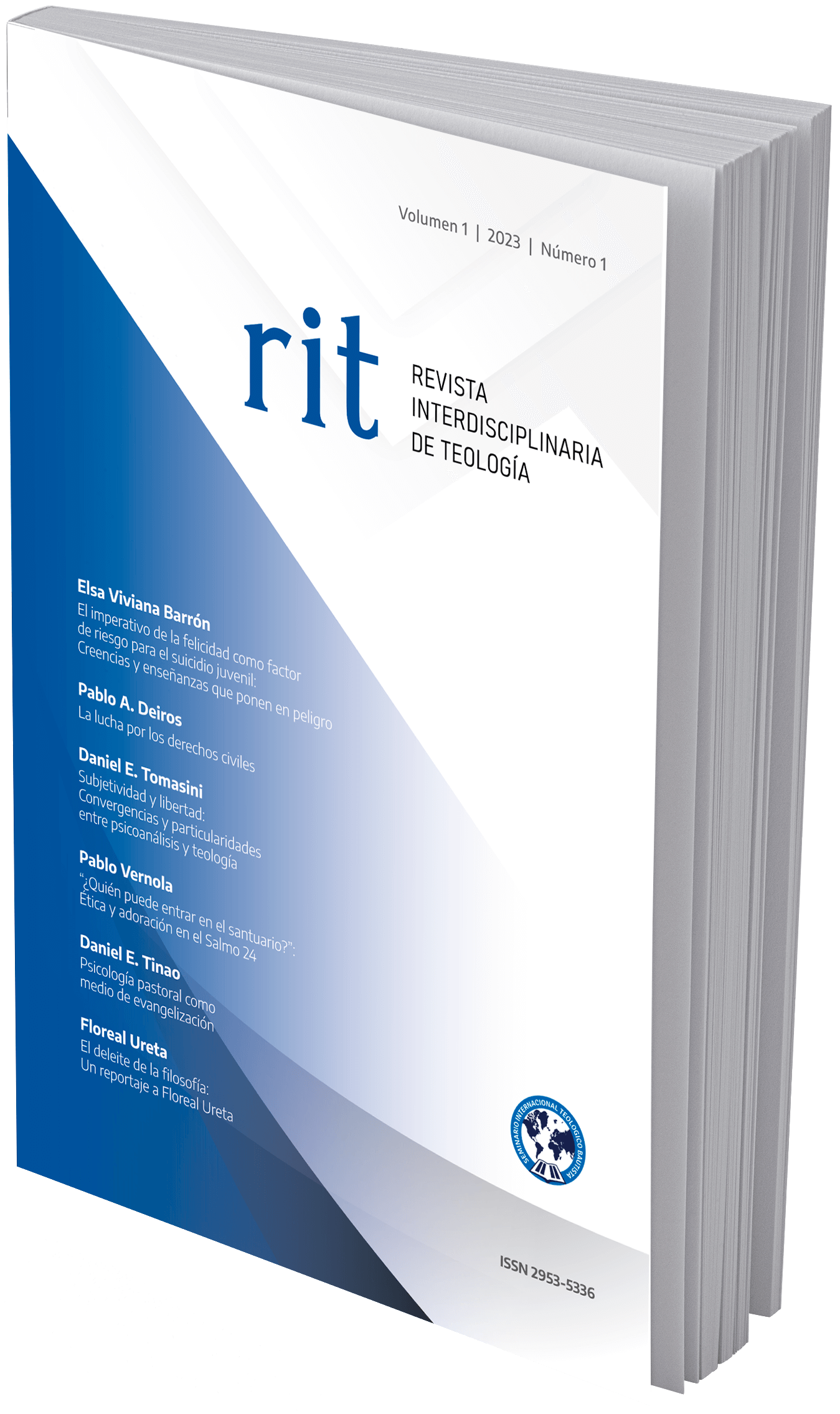
"Who may enter the sanctuary?": Ethics and worship in Psalm 24
Ética y adoración en el Salmo 24
DOI:
https://doi.org/10.67779/rit.15Keywords:
Psalm 24, Yhwh king, Ethics, Worship, Ancient IsraelAbstract
In this work, Psalm 24 will be analyzed as the "Psalm of Yhwh the King." After presenting a proposed translation into Spanish, its literary structure will be analyzed, suggesting the connections between the sections that show how Yhwh Sebaot, who is identified as the "king of glory" and enters the sanctuary (vv. 7-10), expects ethical conduct from the pilgrims to remain in it (vv. 3-6).
Downloads
References
Alonso Schökel, L. (1987). Manual de poética hebrea. Madrid: Ediciones Cristiandad.
Alonso Schökel, L. (Ed.). (1994). Diccionario bíblico hebreo-español. Madrid: Trotta.
Alonso Schökel, L., & Carniti, C. (1992). Salmos: Traducción introducciones y comentario. Estella: Verbo Divino.
Aparicio Rodríguez, A. (2012). Comentario filológico a los Salmos y al Cantar de los cantares. Madrid: Biblioteca de Autores Cristianos.
Barthelemy, D. (Ed.). (2005). Critique textuelle de l’Ancien Testament. Fribourg, Switzerland, Göttingen: Academic Press; Vandenhoeck & Ruprecht.
Brown, W. P. (2010). «Here come the Sun» The metaphorical Theology of Psalms 15-24. En E. Zenger (Ed.), The composition of the book of psalms. Leuven: Uitgeverij Peeters.
Brueggemann, W., & Bellinger, W. H. (2014a). Psalms. New York: Cambridge University Press.
Carbajosa Pérez, I. (2018). Salmos. Madrid: Biblioteca de Autores Cristianos.
Craigie, P. C. (2004). Psalms 1-50. Nashville: Nelson.
Duke, R. K. (2011). Form and Meaning. Multi-layered Balanced Thought Structures in Psalm 24:4. Tyndalle Bulletin, 62(2), 215-232.
DOI: https://doi.org/10.53751/001c.29317Elliger, K., & Rudolph, W. (Eds.). (1977). Biblia Hebraica Stuttgartensia. Stuttgart: Deutsche Bibelgesellschaft.
Erbele-Küster, D. (2016). Poetics and ethics: Psalm 27 as an exemplary reading. Canon&Culture, 10(1), 39-55. https://doi.org/10.31280/CC.2016.04.10.1.39
DOI: https://doi.org/10.31280/CC.2016.04.10.1.39Escuela Bíblica y Arqueológica de Jerusalén. (2009). Biblia de Jerusalén (4a. Ed.). Editorial Desclée de Brouwer.
James, J. T. (2020). Research trends in the study of the ethics of the psalms. Currents in Biblical Research, 18(2), 118-141.
DOI: https://doi.org/10.1177/1476993X18801286Jenni, E., & Westermann, C. (Eds.). (1978). Diccionario Teológico Manual del Antiguo Testamento. Madrid: Ediciones Cristiandad.
Joüon, P., & Muraoka, T. (2006). Gramática del hebreo bíblico (M. Pérez Fernández, Ed.). Estella: Verbo Divino.
Keel, O. (2007). La iconografía del Antiguo Oriente y el Antiguo Testamento. Madrid: Trotta.
Kraus, H.-J. (1995). Los Salmos. Salamanca: Sígueme.
Lambdin, T. O. (2001). Introducción al hebreo bíblico. Estella: Verbo Divino.
Meyer, R. W. (1989). Gramática del hebrero bíblico. Terrassa: Clie.
Mowinkel, S. (1962). The Psalms in Israel’s worship. Oxford: Blackwell.
Owens, D. C. (2013). Portraits of the righteous in the Psalms: An exploration of the ethics of book I. Eugene, Oregon: Pickwick Publications.
Rahlfs, A., & Hanhart, R. (Eds.). (2007). Septuaginta. Editio Altera. Stuttgart: Deutsche Bibelgesellschaft.
Sanz Giménez-Rico, E. (2014). Señor, roca mía, escucha mi voz: Lectura continua y concatenada de Salmos 1-30. Estella; Mardid: Verbo Divino; Universidad Pontificia de Comillas.
Stolz, F. (1978). צִיּ֔וֹן (E. Jenni & C. Westermann, Eds.). Madrid: Editiones Cristiandad.
Sumpter, P. (2014). The Coherence of Psalm 24. Journal for the Study of the Old Testament, 39(1), 31-54.
DOI: https://doi.org/10.1177/0309089214552378Van der Woude, A. (1978). צבא (E. Jenni & C. Westermann, Eds.). Madrid: Editiones Cristiandad.
Vilar Hueso, V. (1963). El Salmo 24: Unidad literaria y ambiente histórico. Estudios Bíblicos, 22(3-4), 243-253.
Downloads
Published
How to Cite
Issue
Section
License
© 2023 Pablo Vernola

This work is licensed under a Creative Commons Attribution-NonCommercial-ShareAlike 4.0 International License.